OFFERTORIALE IV
Psalm 84 (85) – Ψαλμὸς ΠΔ - Psalmus LXXXIV - 84 مزامير
Verse from Old
Testament, Book of Psalms, by Psalmist,
King and Prophet David
|
|
רָצִיתָ
יְהוָה
אַרְצֶךָ |
|
ΕΥΔΟΚΗΣΑΣ, Κύριε, |
|
|
Benedixisti, Domine |
|
|
يَارَبُّ، قَدْ
رَضِيتَ عَنْ أَرْضِكَ، |
|
|
Thou hast blessed, |
|
|
Tu as été
bienveillant, Seigneur, envers la terre. |
Psalmus LXXXIV
2a Benedixisti Domine terram
tuam
2b avertisti captivitatem
Iacob
R/ 3a Remisisti iniquitates
plebis tuae
3b operuisti omnia peccata
eorum
4a Mitigasti omnem
iram tuam
R/ 3a Remisisti iniquitates
plebis tuae
8a Ostende nobis Domine misericordiam
tuam
8b et salutare tuum da nobis
R/ 3a Remisisti iniquitates
plebis tuae
ב רָצִיתָ
יְהוָה
אַרְצֶךָ;
שַׁבְתָּ,
שבות
(שְׁבִית)
יַעֲקֹב.
2a ב רָצִיתָ
יְהוָה
אַרְצֶךָ;
2b
שַׁבְתָּ,
שבות
(שְׁבִית)
יַעֲקֹב.
R/ 3a ג נָשָׂאתָ,
עֲוֹן
עַמֶּךָ;
3b כִּסִּיתָ
כָל-חַטָּאתָם
סֶלָה.
4a ד אָסַפְתָּ
כָל-עֶבְרָתֶךָ;
R/ 3a ג נָשָׂאתָ,
עֲוֹן
עַמֶּךָ;
8a ח הַרְאֵנוּ
יְהוָה
חַסְדֶּךָ;
8b וְיֶשְׁעֲךָ,
תִּתֶּן-לָנוּ.
R/ 3a ג נָשָׂאתָ,
עֲוֹן
עַמֶּךָ;
Ψαλμὸς ΠΔ (84)
Εἰς τὸ τέλος·
τοῖς υἱοῖς
Κορὲ ψαλμός.
2a ΕΥΔΟΚΗΣΑΣ, Κύριε, τὴν γῆν σου,
2b ἀπέστρεψας τὴν αἰχμαλωσίαν ᾿Ιακώβ·
R/ 3a ἀφῆκας τὰς ἀνομίας τῷ λαῷ σου,
3b ἐκάλυψας πάσας τὰς ἁμαρτίας αὐτῶν.
4a κατέπαυσας πᾶσαν τὴν ὀργήν σου
R/ 3a ἀφῆκας τὰς ἀνομίας τῷ λαῷ σου,
8a δεῖξον ἡμῖν, Κύριε,
τὸ ἔλεός σου,
8b καὶ τὸ σωτήριόν
σου δῴης ἡμῖν.
R/ 3a ἀφῆκας τὰς ἀνομίας τῷ λαῷ σου,
Psaume 84 : L’incarnation
du Christ et l’œuvre du salut !
Pour la fin.
Psaume de fils de Coré.
(traduction :
Révérend Archimandrite père Placide
DESEILLE, à partir de la Septante.
2a Tu as été bienveillant,
Seigneur, envers la terre,
2b tu as
fait revenir les captifs de
Jacob.
R/ 3a Tu as remis l’iniquité
de ton people.
3b tu as
couvert tous ses péchés.
4a Tu as apaisé toute
sa colère.
R/ 3a Tu as remis l’iniquité
de ton people.
8a Montre-nous, Seigneur, ta miséricorde,
8b et donne-nous ton salut.
R/ 3a Tu as remis l’iniquité
de ton people.
85 ﺍﻟﻤﺰﺍﻣﻴﺮ
2a يَارَبُّ، قَدْ
رَضِيتَ عَنْ أَرْضِكَ،
2b وَأَرْجَعْتَ سَبْيَ
يَعْقُوبَ.v
R/ 3a إِذْ
غَفَرْتَ
لِشَعْبِكَ
إِثْمَهُمْ،
3b وَسَتَرْتَ خَطَايَاهُمْ
كُلَّهَا.
4a 3 سَكَّنْتَ
كُلَّ سَخَطِكَ.
R/ 3a إِذْ
غَفَرْتَ
لِشَعْبِكَ
إِثْمَهُمْ،
8a 7 أَظْهِرْ
لَنَا رَحْمَتَكَ
يَارَبُّ،
8b وَامْنَحْنَا خَلاَصَكَ.
R/ 3a إِذْ
غَفَرْتَ
لِشَعْبِكَ
إِثْمَهُمْ،
You are listening to a sample of Psaltiki (ecclesiastical
chant, erroneously known as “Byzantine Music”),
in its Ecphonetic or “Gregorian chant” variant,
using a number of biblical verses, in Latin,
from Psalm 84 (85) of
the King, Prophet and Psalmodist David
(“Benedixisti,
Domine”).
MANY links are provided in the end, beneath the
Hellenic text.
ALL material provided
is FREE for DOWNLOAD:
it is to be DISTRIBUTED UNCHANGED,
and is to be USED for GOD-FEARING RELIGIOUS purposes
ONLY.
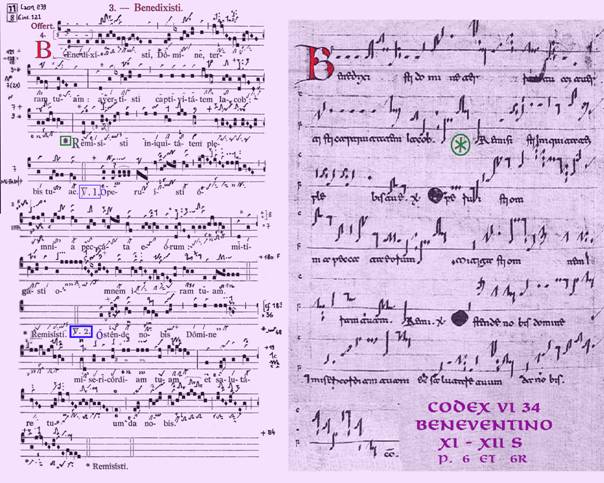
The score on the left comes
from the book of OFFERTORIALES,
the “OFFERTORIALE
TRIPLEX”
edited by Solemnes
The score on the right comes
from
Codex
VI. 34 of Benevent,
(XI – XII century)
also available as facsimiles from
the Abbaye of Solemnes in
The triplex version presents
paleographic neumes above and below
the more contemporary “square notation”.
Above: Laon 239
Below: Einsiedeln 121
with complementary
use
of other paleographic sources.
This Offertoriale
hymn (equivalent to “Cheroubikon”
in today’s Orthodox church),is classified as being of
TONE 4.
Its lines are much more reminiscent of the
psaltic plagal fourth mode
and that’s why I chose a drone
(“isson”) on Ni = Do.
I chant it in manner called
“chronos ecphonetiko-kalophonikos”.
This no longer exists as such in our modern-day Orthodox Church.
What does exist, however, are the following:
Ecphonetic style of the clergy, which is transmitted O/AURALLY, and has only been
transcribed in bits and pieces. I use this style as the FOUNDATION of my
Gregorian chant interpretations.
Listen to Iakovos Nafpliotis
as well as to other audio samples I have provided here.
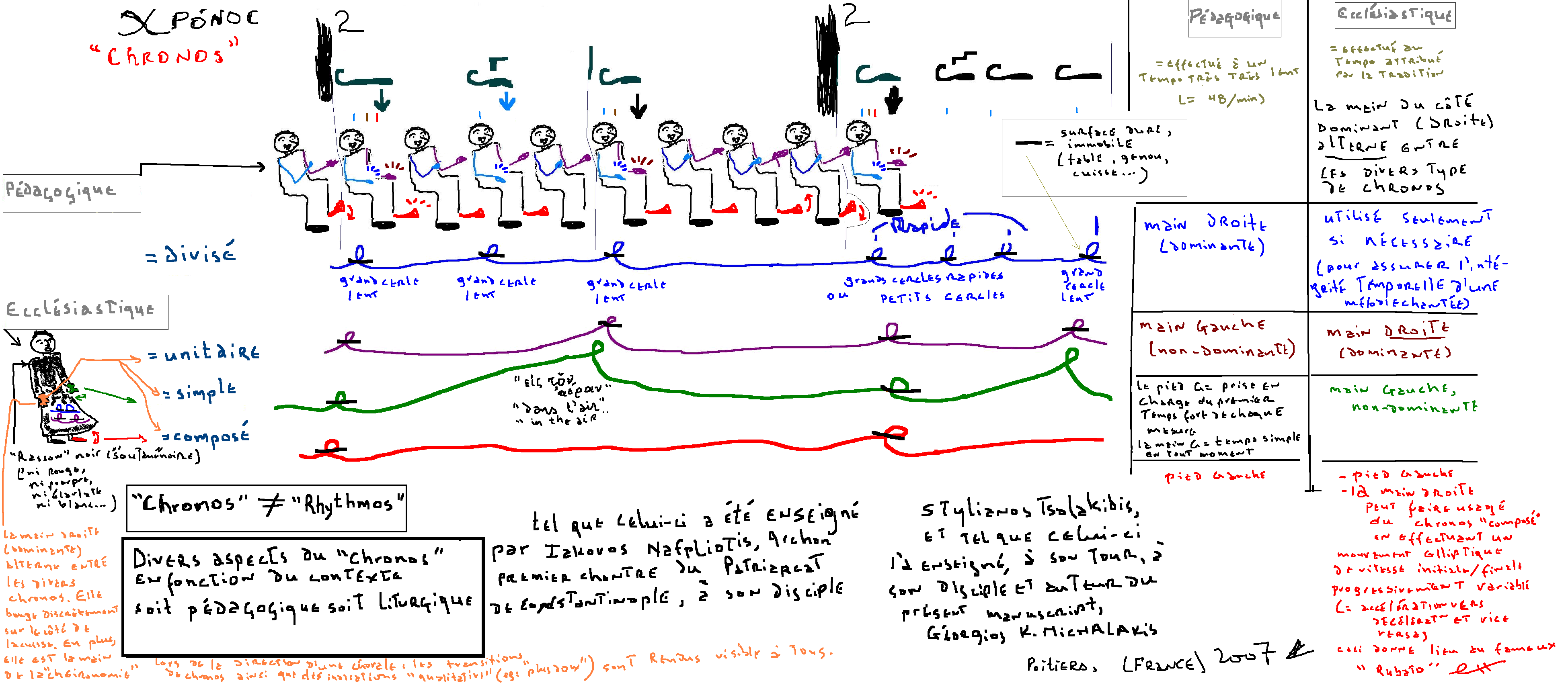
Chronos Eleutheros, which makes abstraction of REGULAR rhythm. This is demonstrated in the
exemplary interpretation of a Communion
hymn by the teacher of my principal master,
Notice that in both of the above, the attacks are “steep sloped” and
with UNEQUAL temporal divisions (“parestigmena”, meta “neurou”)
Chronos Kratimatos, which converts a BINARY rhythm, into many intermediate, more complex
forms, by alternating the SPEED at which the hand moves, sometimes accelerating
or decelerating WITHIN different parts of a measure, thus creating a VARIABLE unit of time, which is something
that has been lost in instrumental music almost everywhere in world, especially
in western society.
Sometimes, the outcome of this process is a “new rhythm” which
corresponds to what was know in ancient
One learns this Chronos by initially counting
using a CONSTANT unit of time,
once in SIMPLE BINARY
and then in SIMPLE TERNARY
(by doubling the first beat)
followed
by
VARIABLE unit of time
which, most of the time,
corresponds to neither of the above.
Read more about this here.
Chronos Kalophonikos: This form of chanting is a bit
sensual, for it uses “smooth attacks” and many “equal temporal divisions”, and
it is for this reason that it was used for hymns that were chant AFTER the end
of some religious ceremony.
Finally, one has to make a link between musical lines that are known by
heart in Psaltiki and those that are encountered in
Gregorian chant.
This is done by studying the “skeleton” of the melody, otherwise known
as “metrophonia”,
WITHOUT taking into consideration note durations.
The following documents
Relationship Psaltiki Gregorian
and
Psaltiki - Gregorian Complementarity

attempt
to explain how the two written forms of this heritage are COMPLEMENTARY:
while BOTH define
METROPHONY,
one emphasizes rhythmic structure
while the other emphasizes VARIATIONS in unit of time.
The latter leads to making some notes LONGER and
others shorter,
with NUMEROUS VARIATIONS in length,
a phenomenon which has unfortunately DISAPPEARED in
modern
Gregorian square as well as psaltic notation.
Fortunately, this has been saved in the o/aural tradition up to Iakovos Nafpliotis, and
completely disappeared with Thrasyboulos Stanitsas.
Ever since, psaltiki is condemned to its
extinction, in spite of what some world famous “specialists” claim to otherwise
ignorant audiences willing to accept anything that can entertain them from an
otherwise repetitive occidental musical repertoire.
In summary, one notes that I have used quite a number of parameters so
as to provide an interpretation which can, of course, have other variants as
well, depending on how one decides to “balance out” these various components of
Metrophonia, Rhythm, Chronos
and Attacks.
Rhythm corresponds to that of the TONIC sequence of the words as they
are pronounced.
One should keep in mind, however, that contemporary
Latin is not exactly pronounced or even accentuated as it was back then!
Finally, although paleography might show a “Si”,
contemporary square notation sometimes uses “upper Do” instead.
I decided to initially follow the square notation, all in welcoming
remarks from Gregorian chant specialists, so as to eventually make a new
version with the appropriate corrections they’d be willing to indicate.
In the version you are listening to, I decided to use “smooth attacks”, since I’m chanting while sitting in front of my computer
(you can even hear children’s voices as they come out of their school across my
apartment).
I was dead tired
- physically ,
morally and spiritually.
I did not try to do anything “technical” or “fancy”.
I simply chanted as if I was at
the “end of it all”.
There are a number of mistakes, of course.
Yet, as I’ve claimed elsewhere, God has given me an average voice, and most of
what comes out and at times might even sound “decent” is more because of long
and laborious study of this holy tradition than anything else.
God listened to my prayer,
and helped me back then.
I’m slowly learning the piece by heart, and I’ll chant if FREELY someday
in the large cathedral next door.
Who knows, it might end up sounding more vivacious and even better.
I believe that any child with a talented voice listening to this will
end up learning it and performing it better.
Therefore, my objective is to simply “stimulate” interest in Gregorian
chant, and not to pretend that I am some vocally “talented” singer.
I chant according to what I have learned from many masters, the main one
being Stylianos Tsolakidis (+1987), student of Iakovos
Nafpliotis (1864-1942), the Greatest ever psaltis to have been recorded.
I DESPISE contemporary church and even folklore music as it has evolved
in the Orthodox world, given that many people with talented voices perform
WITHOUT adequate or even appropriate knowledge/exercise of Traditional psaltiki, while being motivated by the unique concern of
becoming “superstars”, which most have achieved at the expense of this Holy
tradition.
My efforts in psaltiki has been blessed by
the Patriarch of Constantinople Bartholomeos I
(personnal
letter and Benediction)
the Pope of
(two letters and Apostolic Benediction)
Πρὸς τὸ γένος
τῶν Ἑλλήνων
Οἱ
στόχοι τῶν καταπολεμούντων
τὴν Ἑλληνικὴν
ταυτότηταν,
ἤτη, τὰ
« ΑΙΜΑ, ΓΛΩΤΤΑ καὶ ΗΘΟΣ» ἡμῶν, ἔχουσιν
ἐπιτευχθῆ
χάρην εἰς τὴν
Μεγαλομανείαν
διαφόρων
« φορέων » τοῦ
διὰ αἰώνων
ἔχοντος
ΕΠΙΒΙΩΣΕΙ Πατροπαραδότου
Πολιτισμοῦ ἡμῶν, οἱ ὀποῖοι « φορεῖς » , χάρην
εἰς τὴν
φρενοβλαβὴν
ξενομανίαν
αὐτῶν, ἔχουσιν ΕΝΤΕΛΩΣ λοβοτομήση
καὶ εὐνουχήση
τὰς τελευταίας
δύο γενεὰς
ἐκ τοῦ
ΜΕΓΑΛΕΙΟΥ
τῶν κατ ἐξοχὴν Ἑλληνικῶν
ἀξιῶν, ἐξ ὅν
τὸ φιλότιμον, ἡ λεβεντιά, ἡ φιλοξενία, ἡ γεναιοδωρία, ἡ ἀνιδοτέλεια
καὶ ὁ ΑΚΡΑ σεβασμὸς
εἰς πατροπαράδοτους
θεσμούς.
Ὅσον ἀφορὰ τὴν ψαλτικὴν, αἱ διάφοραι παρεκτροπαὶ
ὅπως ἡ
εἰσαγωγή
μακαμιαζόντων
λειτουργικῶν
ἀπὸ τὸν
Πρίγγον, καὶ μυριοβόλων
ἀμανεδο πλαγιαζόντων
λαρυγγισμῶν
του Στανίτσα, ἔγιναν
αἴτιον εἰσαγωγῆς δυτικοφρόνου προσεγγίσεως
τῆς ψαλτικῆς
ἐντὸς τῆς κοινῆς
προσευχῆς,
τουτέστι, ἐπίδηξην προσωπικῶν
ἢ ὀμαδικῶν ἰκανοτήτων,
μὲ ἀπότερον
σκοπὸν τὴν ΑΤΟΜΙΚΟΠΟΙΗΣΙΝ
και ΣΦΕΤΕΡΙΣΜΟΝ
τῆς ἱερᾶς
ψαλμωδίας
πρὸς χάρην
δόξης
και « superstar »ισμοῦ. Τὸ ἀποτέλεσμα
εἶναι νὰ
ὑπάρχῃ τὴν σήμερον
ἡμέραν, ἀντὶ ΠΑΤΡΟΠΑΡΑΔΟΤΟΥ
ψαλτικῆς, ἓνα ΜΑΓΜΑ
ΤΡΑΒΕΣΤΟΠΟΙΗΜΕΝΗΣ
μουσικῆς,
περιεχούσης
ὄτι τὸ
ἀντιπαθητικὸν
ἀκόμη καὶ
βάσει
κριτηρίων τῆς ἀρχαιότητος =
ἀῤῥυθμίαν, ἀπαλμίαν,
ἐπιγείως ἀνύπαρκτα διαστήματα,
ἀνομογενές ἔκφρασιν, ἰσόχρονες διαιρέσεις
χρόνου μὲ θυληπρεπές ἰλαροχορευτικὸν
ἄκουσμα, κτλ.
Ἐκ τοιοῦτου εἴδους ΑΝΤΙΠΑΡΑΔΟΣΙΑΚΗΣ
καὶ ΙΔΙΟΡΡΥΘΜΟΥ
ἀσματωδίας
τρέφεται ἡ σύγχρονος
Ὀρθόδοξος
νεολαία =
Στανιτσο
τσιφτετελο
μυριοβολο
λαρυγγισμους,
Καραμανο οὐρανισματο
ἐκλειψεις,
Ταλιαδωρο
αχρονο μεθυσο ἠχείας,
Bασιλικο ὀνειρομουσικοβασίας,
Αρβανιτο
φαλτσο βορβορυγμο κραυγες,
Μαννο
Καραντζο χαυνοεισπνοὲς
τε καὶ συγκινήσεις,
Σιμωνοπετρίτικα
καλαντο βαλτσάκια,
Γαϊτανο-Καβαρνο
νεο κυμα
θεατρισμους,
Σιμωνοκαραϊτικο
ὀμαδικο
φαλτσαροντο
ἰλαχορευτικες
ἐκτελέσεις
ἀκόμη καὶ ἐν Ἁγίῳ
ὄρει ,
κτλ.
Πολλοὶ ἐξ αὐτῶν
καυχῶνται περὶ « Πατριαρχικοῦ », « Ἁγιορίτικου » ἢ καὶ
« « Ἁγιο σοφίτικου »
« ὕφους »,
τὸ ἐπὶ
τῷ πλεῖστον
αὐτῶν βασιζόμενον ἐπὶ ἐκ
δημοσίου χρηματοδωτημένης
παπυρο «ἔρευνας », κατὰ
« μεθολογίαν »
παντελῶς ΑΝΤΙ ἐπισημονικὴν,
διότι ἀνεξήλεκτον
ἐκ τῶν
θετικῶν ἐπιστημῶν, καὶ
ἐν τέλει
τόσον χυδαίαν
ὅσον ἡ
τραβεστοποίησης
αὐτῶν τῆς ΠΑΤΡΟΠΑΡΑΔΟΤΟΥ
μουσικῆς ἡμῶν.
Μία ἦτο ἡ
Ψαλτικὴ, πρὸ τῆς
δυσμελήσεως
αὐτῆς παρὰ τῶν
διαφόρων
ΣΥΜΦΕΡΟΛΟΝΤΟΓΙΚΩΝ
παρατάξεων
= αὐτὴν
ὄπου ἀντιπροσωπεύη ὁ
Ἰάϰωϐος
Ναπλιώτης.
Γεώργιος
Μιχαλάϰης
Πρωτοϰανονάρχου
μαϑητής.
LINKS
Relationship Psaltiki Gregorian
Master of my teacher, Iakovos Nafpliotis –
biography and recordings
Key words
Iakovos, Nafpliotis,
GKM, Tsolakidis, Georgios, Géorgios, Michalakis, byzantine,
music, psaltiki, gregorian,
chant, βυζαντινή.
μουσκή,
Μιχαλάκης.
Γεώργιος.
Ιάκωβος
Ναυπλιώτης
Τσολακίδης,
γρηγοριανό
καλοφωνικος,
ειρμος,αινείτε,
κοινωνικον, Benedixisti,
offertorial, offertoriale
Iakovos Nafpliotis
GKM Tsolakidis Georgios Géorgios Michalakis byzantine music
psaltiki gregorian chant
βυζαντινή.
μουσκή
Μιχαλάκης
Γεώργιος
Ιάκωβος
Ναυπλιώτης Τσολακίδης
γρηγοριανό
καλοφωνικος
ειρμοςαινείτε
κοινωνικον